
A Surprising Rx
What we can learn from physicians—and museums—about getting more comfortable with uncertainty

For millennia, philosophers like Socrates and Confucius have written that real sagacity isn’t knowing all of the answers. Rather, “the only true wisdom is in knowing you know nothing,” an idea attributed to Socrates, taken from Plato’s Apology.
And yet, outside the land of philosophy, many of us live lives in which we feel pressure to, well, know something. Consider the parent whose kid is asking “why” for the thousandth time. Or the executive facing a stony-faced board member demanding an explanation for low quarterly returns. Or a political party grasping for answers about why they lost an election.
The challenge is bi-directional: On the one hand, it would be great if the people demanding answers from us could, like Zen masters, accept that we don’t know everything. But since we don’t have control over others, we have to focus on our own relationship to uncertainty, and how we react under the pressure. Will it force us to rush to conclusions or seize on the wrong answer too quickly? Will it make us feel inferior for not knowing? Or can we imagine another way to handle those situations?
The Doctor’s Dilemma
For medical practitioners, the pressure to provide answers can be crushing. With limited information and time, they’re expected to deliver a diagnosis and recommend a course of action. They don’t have the luxury of sitting for weeks, or months, in an open question the way a philosopher might. At the same time, if they seize an answer too quickly, if they’re too quick to spot a pattern from noise, they may put a patient’s life at risk.
This is a balancing act Deepu Gowda has worked his entire career to get right. Gowda is a general internist and assistant dean for medical education at Kaiser Permanente. The question he grapples with: How can he address the uncertainty discomfort many patients feel without caving to the false certainty of more information, often in the form of unnecessary tests?
Getting comfortable with uncertainty in medicine is essential for patients and doctors because it is an inherently uncertain practice, Gowda explains. Take the evidence base: We know a lot, but there’s also a lot we don’t know. And even what we think we know can be pockmarked with bias because many therapies aren’t tested on women, people of color, or people within different socioeconomic strata. All of this, he says, makes communication with patients challenging. We can wax poetic all day about the value in acknowledging our ignorance, but when it comes to questions of health, most of us just want to know what’s going on. And we want to know now.
What’s Behind Our Desire For Answers?
When Gowda interacts with patients who want more certainty in the form of additional tests, this prompts a larger question: What is the patient really seeking?
What are any of us seeking when we demand answers—from ourselves, others?
Testing, and answers, can serve as a proxy for attention and care, Gowda explains. If a doctor orders another test, a patient can interpret that to mean “I haven’t forgotten about you. I do care about these symptoms. I believe you.”
Instead of ordering more tests, Gowda addresses this need at the root: “I spend even more time listening and especially examining a patient,” he says. “You can have 15 minutes with someone, but if you are present with that person in 15 minutes, time expands. The space expands. The relationship can transform.”
Curiosity is the Uncertainty Counterweight
In those fraught, uncertain moments, Gowda asks his patients questions. He looks them in the eye. And he says: When would you like to come back to see me? His goal is to make clear that he is not abandoning them.
“This doesn’t work every time,” he says. “But I’ve found it to be a way out of my own discomfort with uncertainty—to be present, go back to those foundational skills of listening, being curious, and wanting to know the nuance [of someone’s situation].”
In other words, he recognized that his value to the patient in those moments wasn’t necessarily knowing all of the answers. It was patiently waiting with them, helping them hold their heavy questions so they didn’t buckle under the weight.
Art Lessons
How did he learn this skill? And can others? For decades, medical schools and physicians like Gowda have experimented with a way to help students—and, by extension their patients—get more comfortable with uncertainty.
Their state-of-the-art and research-backed tool? Art.
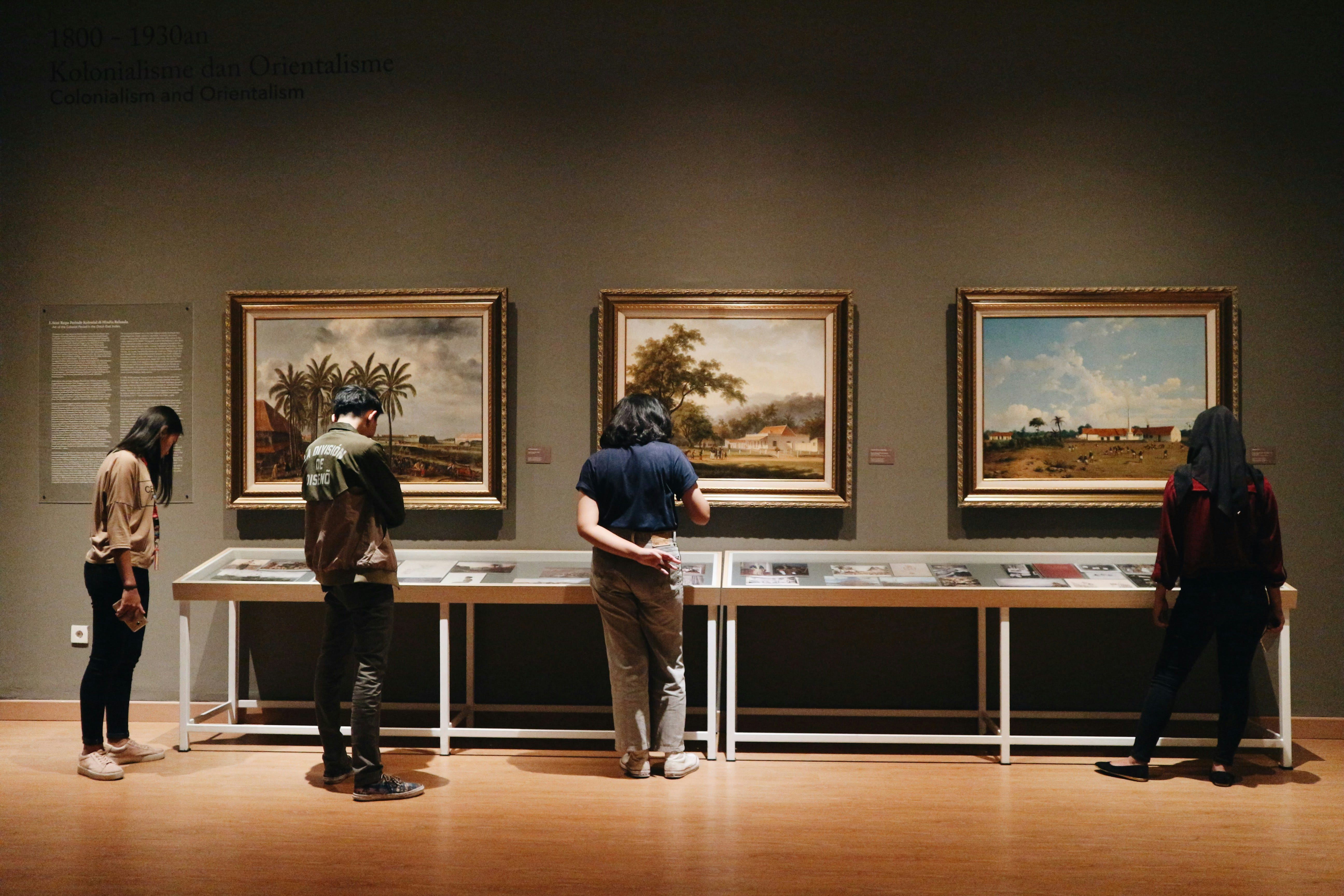
Starting in 2005, Anne Willieme, Founder and Director of ArtMed insight, developed curricula for students at medical schools including Columbia University, New York University and Cornell University, in collaboration with physicians. Willieme—who now aims to work beyond medicine as well—often takes students to observe paintings at the New York Metropolitan Museum of Art. But even if you don’t have a museum near you, the techniques they use are ones that any of us can deploy to help live with the pressure to spew or seek quick answers.
Slow down and observe. “As you slow down the process of seeing and pause, you allow for more information to come up,” Willieme told me. “It’s a way of moving out of our conditioned and automated responses, and opening up more space to see anew.”
Consider a different story. In one exercise, Willieme asks her students to observe an ambiguous painting, come up with a storyline to explain what’s happening, and then come up with an entirely different storyline.
Try another perspective. In another exercise, she encourages them to observe a piece of art from the perspective of people with different professions, asking how they might view its meaning differently.
Souvenir For the Future
What can you take with you the next time you feel pressured to know the answers? For me, the biggest lesson from Gowda and Willieme is simple: Sometimes, the pressure we feel to know the answer comes from manufactured urgency. Sure, there may be times when someone needs to know an answer right now. But often, what they really need, and want, is to feel seen and heard.
What about you? What are some lessons you’ve learned that help when you feel pressured to give an answer on a timeline that feels too fast? Please feel free to share your experience in the comments.
Thank you so much for being part of this community.
Elizabeth
P.S. In the next newsletter, we’ll discover what it looks like to explore the big questions of our lives—past, present, and future—with a questions map. Plus, I’ll be sharing a special gift with paid subscribers!