
The Problem with Oracles
On finding new ways to peer into the future

If you’re just joining me here at Time Travel For Beginners, hello 👋! I’m so glad you’re part of the community. I’m the author of How to Fall in Love With Questions: A New Way to Thrive in Times of Uncertainty, and you can snag your copy here.
By all historical accounts, she was the closest thing humans had to a God on earth. One of the first descriptions of her prescience came from Homer, who wrote about one of her prophecies—a predicted fight between Achilles and Odysseus—in The Odyssey.
Her acolytes—including people like Plato, Socrates and Aristotle—continued to write and speak about her for millennia. They said she could read minds, see far away events, and, perhaps most importantly (for this Substack), predict the future.
Philosophers, kings, and regular citizens made the pilgrimage to behold this all-powerful woman and ask their questions. Before entering her lair, they would have glanced at an inscription carved on the wall: Know thyself.
This omniscient woman, the Oracle of Delphi, may have been the world’s first fortune teller. For centuries, her prophecies slaked the human thirst for the answer to the enduring question: What will happen next?
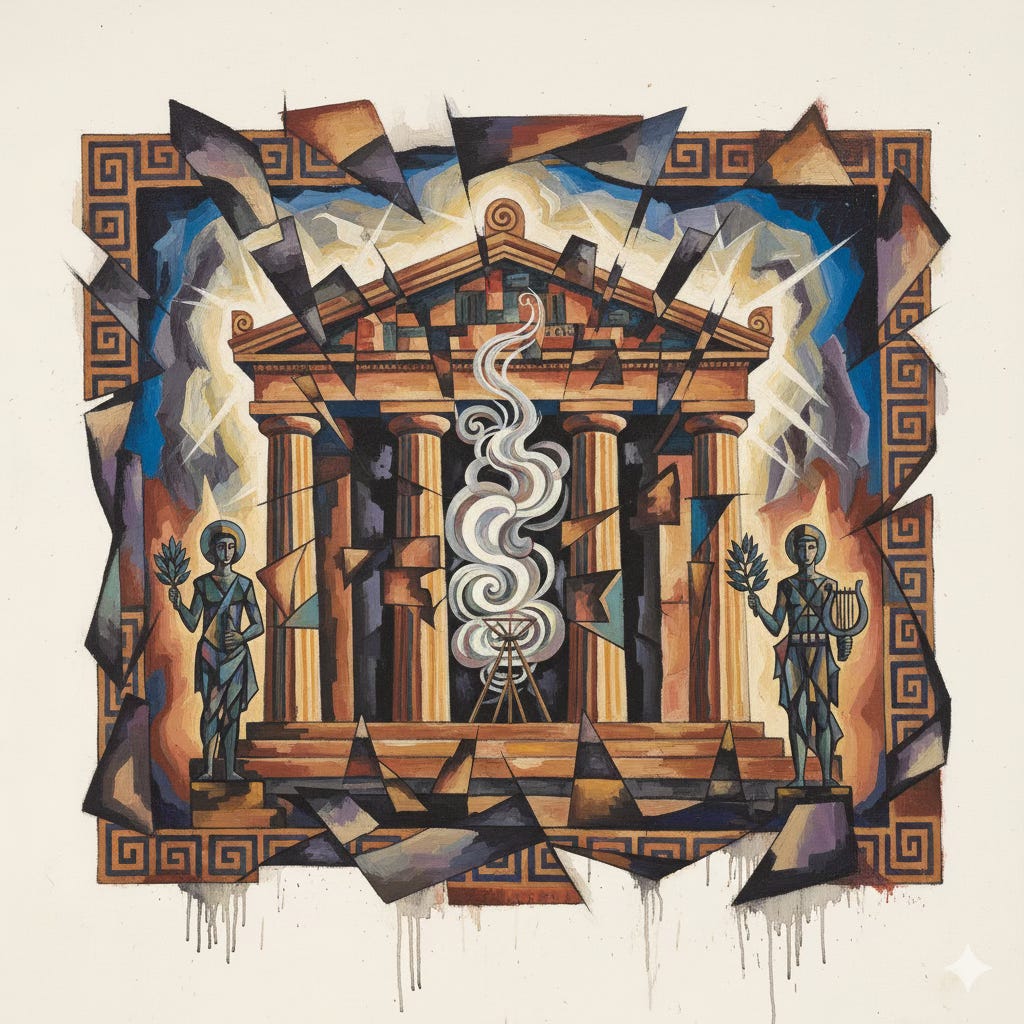
The journalist William J. Broad describes her clout in the ancient world: “No seer or diviner stood higher,” he writes in his book The Oracle: Ancient Delphi and the Science Behind Its Lost Secrets. “No voice, civil or religious, carried further. No authority was more sought after or more influential. None. She quite literally had the power to depose kings.”
According to records, the Oracle was the voice of the god Apollo. Represented by multiple women across generations (“a sisterhood of mystics”) she reigned from the mountains of Delphi in Greece. Perched in a cavernous den, she inhaled pneuma (possibly the analgesic ethylene) seeping in from vents in the rock. Some scientists suspect this created the conditions for her visions.
To me (and, it seems, to Broad), the most interesting part of the Oracle’s story is what remains unexplained by science. Indeed, one of the scientists who led the modern work to uncover the basis of the Oracle’s abilities noted that his team’s discoveries could not explain “the Oracle’s cultural and religious power, her role as a font of knowledge…whether she really had psychic powers…how her utterances stood for ages as monuments of wisdom…how she often worked as a catalyst, letting kings and commoners act on their dreams,” Broad writes. “In futility, the situation was like attributing masterworks of twentieth century literature to the fact that major authors indulged in heavy drinking.”
Today, though we do not have an Oracle, we continue to seek sources who claim an ability to peer into the future. One recent Pew study reports that 30 percent of American adults say they consult tarot cards, fortune tellers, or astrology at least once a year, mostly for entertainment. There is still a debate among scientists who study paranormal or spiritual phenomena over the existence of what’s known as precognition. While some scientists have found what they argue is evidence for these abilities, others counter that these results have too small a sample size, or that there are serious flaws in the research methodology.
It’s easy to get caught up in the question of what’s scientifically valid and what’s not. And to be sure, that’s a critical question to ask. But the binary nature of it—is it real or fake, true or false—can also obscure the existence of a kind of intellectual middle ground, and a a more challenging question: What might both practices, the intuitive and the scientific, have to teach us?
We can start to answer this question by exploring another community trained in the arts of foresight, and the people within it who are considering how to integrate the intuitive prowess of the Oracle with evidence-based scientific tools.
