
Why Do Humans Explore?
In his new book, Alex Hutchinson digs into the emerging science of why we’re drawn to the unknown

It seemed like Alex Hutchinson had gotten everything he’d ever wanted. In 2018, his first book, Endure, became a New York Times bestseller, positioning him to continue writing about a subject he’d become passionate about years ago: the science of endurance. The proverbial mist had lifted, revealing a clear career path towards a known destination. But this, for Hutchinson, was the problem. “At first, I thought this was my dream,” he told me, recounting the early days of book success. “But I eventually experienced the desire to do something else. There wasn’t something specific I wanted to do, but I just knew I wanted to do something different, where I didn’t already know the outcome.”
He knew, rationally, that “there were all sorts of reasons to stay on the career path I was traveling.” What, he wondered, was drawing him off of it? And what draws so many of us off the beaten path, towards unexplored territory?
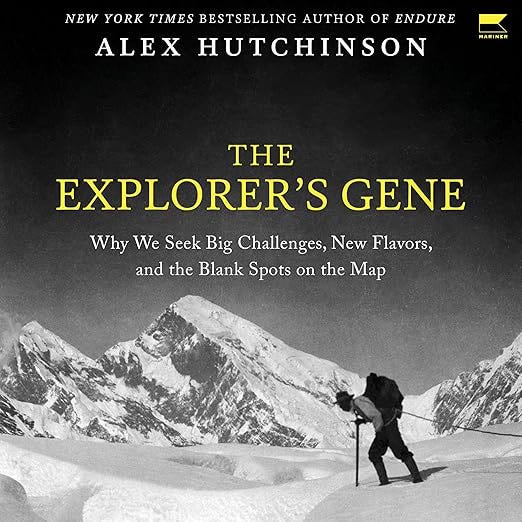
In his latest book, The Explorer’s Gene: Why We Seek Big Challenges, New Flavors, and Blank Spots on the Map, Hutchinson synthesizes cutting edge scientific research, historical records, and his own personal story to brilliantly answer the enduring question: why do we explore?
I was lucky to get to speak to Hutchinson about the book; we discussed everything from the impact of social media, aging, and parenting on exploration, to which explorer from the past he’d most like to adventure with. Our edited conversation is below.
EW: I’m curious if you can explain what the “uncertainty bonus” is, and share some strategies you've seen people use to maximize this benefit in their lives?
Alex Hutchinson: The uncertainty bonus is the idea that we value things whose outcome is unknown more highly than we “should.” If we were approaching the world as strictly a series of gambles with odds and payoffs, we would always opt for the choice that has the greatest likelihood of the highest payoff. But in fact, we don’t typically do that. We sometimes pick what seems to be losing bets precisely because we don’t actually know what the payoff is going to be.
What we get out of that is information. So by picking the lesser-known choice, we may have a smaller chance of hitting the jackpot, but we learn about what’s down that road that we haven't traveled before. So what some scientists in the field call the “uncertainty bonus” is actually an information bonus. Instead of looking for a jackpot, we’re just looking to find out new things about the world, with the idea that that’s going to lead us to greater payoffs in the future.
A practical example of that is if you analyze the data from food delivery companies (as scientists have done), you find that when people order from a restaurant they’ve never ordered from before, they’re more likely to get a worse meal than if they stick with their favorites. In this case, people are making a choice that's short-term irrational. But in the long term, if these people continue to explore, their options improve because they’re getting information about restaurants that are really good that they haven’t encountered before.
This is an example of the uncertainty bonus. People are willing to say, “I don't know much about this restaurant, but instead of going to that other restaurant I know is good, I’m going to try this unknown one in case it's great.”
Usually it’s not, but sometimes it is! And so by being willing to seek out that information, you often end up with better outcomes over the long term.
EW: Let’s talk about the passive consumption of social media—what kind of impact does this have on our instinct to explore the uncertain and unknown?
Alex Hutchinson: This is a big topic. One way to think about this is that we like sweet things, but living in a world that’s basically a giant buffet of sugar has turned out to be not so good for us. It’s not that the instinct to pursue calories is a bad one; it’s just that it gets way out of balance in the modern food environment.
I think that’s a straightforward analogy to the modern information environment. It often leads us to us sit passively and gorge ourselves, to the exclusion of actually doing anything in the real world.
One of the resolutions that I've come away with after writing this book is that maybe I don’t need to research everything quite so thoroughly. Like, maybe I can go on vacation or go on a hike without looking at 17 travel blogs. Maybe I can buy a kitchen gadget without 10,000 people having approved of the ergonomic design of the handle or whatever.
People often ask me now: Why do we explore? What are we looking for? And I think there are two basic types of answers. One is that exploring leads to good things. You gain information about the world, and you're able to move through the world more effectively. The other is that exploring feels good. It’s satisfying. You have a sense of purpose, of meaning, of excitement.
Those two things are linked in the same way that the pleasant taste of sugar is linked to the pursuit of useful energy to fuel your body. But in the modern world, they can become separated.
So when you’re passively consuming social media on the internet, you’re often just pleasuring your exploratory circuits without actually learning something useful about the world.
EW: I love that.
Alex Hutchinson: It’s not that I think all exploration has to be utilitarian, by the way. But I think you can get caught in a loop where you're pursuing information on the internet because it feels good, and it feels good because it’s supposed to be teaching you about the world, but it’s not; it’s just trapping you in that loop.
EW: It’s the illusion of exploration—which stimulates the same brain regions maybe, but it’s not actually giving you the benefit of exploration that comes from challenge.
Part of what I hear you saying is that what makes exploration meaningful is that it comes with friction; it comes with hard-won lessons that actually teach us about the real world that you're not going to get if you're just watching videos or scrolling passively on social media.
Alex Hutchinson: If you have a purely utilitarian view of exploring—that its sole purpose is just to discover new information about the world—then AI is the greatest thing ever. Because now I have a device in my pocket that can theoretically tell me anything I want to know, but I don’t find that a satisfying way of knowing or learning or being.
In my view, exploring becomes meaningful when it involves uncertainty. This is far more uncomfortable, but meaningful exploration requires grappling with the unknown, facing uncertainty, and hopefully resolving some of it (though not always). Having the chance of failure is important—which gets into a whole other topic of what makes something feel meaningful. Dealing with challenge is part of it.
But the exploration that involves lying on the sofa and surfing the web—even though it’s tripping those dopamine circuits—probably doesn’t leave you feeling like you spent your afternoon with purpose and meaning, and that you’re glad you did that.
EW: Speaking of purpose and meaning, you write about your kids in the book, and your experience as a father. You alluded to the fact that there was a time when your kids were really young when you didn't feel the same drive to explore the world; you felt like you were getting a lot of that from your experience as a new dad. As somebody with a young kid right now, I can relate. I’m curious how your experience as a father has changed your relationship to exploring and to uncertainty.
Alex Hutchinson: There are pushes and pulls. Parenting young children is overwhelming. In the beginning, I definitely noticed a contraction of my desire to explore. For a while, I was fine listening to the same albums that I was listening to 20 years ago and rereading my favorite books. I didn’t need to plot a trip through the jungles of Papua New Guinea. I just wanted to go places that are comfortable and familiar.
However, having young children has also reawakened my appreciation for exploring closer to home, in the world around me.
As my kids have gotten older, it’s been an absolute joy to look around my neighborhood and explore with them. It’s been exciting to go down to the river a block from my house and explore the river valley, the trees, the way the water moves, and build things and have them float in the river. It’s like being a kid again. What I mean by that is I am more open to discovery and surprise. I’m more comfortable saying: “Let’s just find out what happens when we do this.”
It’s easy to be jaded and lose that as an adult—having kids is a great way to reawaken that part of yourself.
EW: Some research suggests we get more curious as we age. However, many people (including myself) feel like as they get older, they become less comfortable with different forms of uncertainty—everything from trying a new restaurant to taking a trip that's more adventurous.
For me, there’s a pull that I never used to feel towards what’s familiar. I’m curious to hear what your experience has been with that, and how you think about the relationship between exploration and aging.
Alex Hutchinson: My starting point when I was working on the book was the mathematical logic that suggests you should explore less as you get older because exploring has more value when you have more time to enjoy the fruits of whatever you discover. As you get closer to your end point—whether it’s in the context of a game or in the context of your life—you have less time, so there are fewer benefits to exploration. Meaning: you might as well stick to the stuff you already know you like.
My instinct was to push back hard against that. Just say: “That's ridiculous. There’s no reason that at 49 years old I should be any less exploratory than I was when I was 15.” I had some conversations with scientists that kind of moved the needle for me a little bit. Basically, they made the point that you can’t unlearn the experiences that you've had as you go through life.
Part of being exploratory when you’re young is that you just don't know. You don’t know whether you like free jazz or what it feels like to drink a pint of gin. But in the fullness of my middle age, I know what happens when I drink a pint of gin. I know what happens when I listen to free jazz, and I don't need to explore those things anymore. I have knowledge about the things that bring me pleasure.
It would be kind of perverse of me not to take advantage of that knowledge. I’ve spent several decades on this planet figuring out the things that I like, so I should love that routine because I know precisely how good it is. That doesn’t mean I want to get entombed in that routine though.
In some of the explore-exploit research I came across, about 20% of older adults became really averse to any sort of uncertainty. They just wanted to stick with what they knew, even when it was clearly to their benefit to explore. And so you don’t want to be part of that 20%, I think.
Personally, I still want to leave space for discovering new things, being uncomfortable, and getting into situations where there’s actual risk.
Obviously though, if I’m out in the backcountry and contemplating: “Should we try and paddle through these Class IV rapids or should we portage around them,” I’m probably making a mistake. The reality is: I have two kids at home. That type of risk is just not for me at this point in my life. And so there are lots of reasons that it’s rational to be a little more cautious about uncertainty as you get older.
EW: What might exploration look like for you in the future then—both in terms of the physical spaces you might explore, but also the big questions in your life that you want to explore for your own personal development?
Alex Hutchinson: One of the underlying motivations for this book was trying to understand what I wanted out of life. When I started out as a journalist, I thought: if I could just write for a running magazine. And then that became: if I could just publish a book. And then that became: if my book could just somehow become a bestseller—that’s all I want. And then I got those things.
This has been a topic for philosophers since time immemorial, but what are you supposed to do after you’ve achieved your dream? Do you have to discover an entirely new set of goals, or can you just be satisfied with where you've gotten to? This to me is connected to the explore-exploit paradox.
I’m in my late forties now and I can't retire, but I have to decide what it is that motivates me. Writing this book has given me an opportunity to think about these things, but I don’t think it’s given me lasting answers. To your point of loving the questions, I think I’m going to live with this question for the rest of my days.
EW: That resonates so much. I, for so long, was fixated on my book. It was a long, hard road to write it and then get it published. There's something very strange and paradoxical about how it feels when you reach a major professional milestone. People talk about this all the time, but you don't really realize it until it happens to you.
Alex Hutchinson: People can tell you what you’re going to feel, but you don’t know until you experience it.
EW: It feels good—but it doesn't feel as good as I thought it would. The reality is that it feels kind of flat. It’s just like, “Yeah. Oh. This has happened.” I'm so grateful, but it doesn't have the emotional texture and vibrancy that other life experiences have had.
Alex Hutchinson: I had good training for this because I spent a lot of time as a competitive runner. It was the most important thing in my life through my late twenties. I had dreams of what I would achieve, and I didn’t achieve all of my goals, but I achieved some of them. And when I would hit one of my milestones, I noticed this pattern starting to take shape.
You cross the finish line, you’ve done this thing you've always dreamed of doing. You’re like: “I’m so happy.” But then the achievement of one goal immediately gives birth to the next goal. And then you wonder: “Why am I already thinking about the next goal? I finished the race like eight minutes ago!” And that happens over and over again as a runner. If you achieve what you wanted, you realize there’s always another rung on the ladder.
My biggest dream back then was that I wanted to run on a national team. And I remember making my first national team, and it was such an amazing feeling. And then within a half hour, I was already starting to think: “Okay, how am I going to do in this international competition now?”
I dreamed of making that national team for six or seven years. And boy, the feeling of happiness after achieving it moved by quickly.
At the same time, without goals, life gets boring. So my conclusion is that you need to be pursuing something and you need to believe it’s going to matter, but you also need to keep in mind that it’s not going to matter quite as much as you might wish.
EW: It reminds me of a book I recently read called The Art of the Interesting by Lorraine Besser. Her research suggests that we’ve inherited this ancient dichotomy of what makes a life “the good life.” And that dichotomy says a good life is one where you’re pursuing happiness or pleasure, and meaning or fulfillment. And so historically we’ve focused on family and friends for happiness and pleasure (and maybe some other things), and then career for the meaning and fulfillment part.
But what her research suggests is that there is actually a third element of what makes life “the good life.” It’s what she and fellow researchers call “psychological richness.” These are experiences that open our mind in some way, or leave a lasting emotional impression on us. Maybe it’s an experience of awe or that feeling you experience when curiosity ignites in your brain, and you just want to know more for the sake of knowing.
Alex Hutchinson: Very compelling. And it sounds to me like it might fit with this idea that exploring gives you experiences. When you explore, you’re not looking for meaning; you’re looking for something else—something interesting fundamentally.
EW: Are there other questions that you’re still curious about after writing The Explorer’s Gene, as a journalist and an explorer?
Alex Hutchinson: The thread in the book that I find myself thinking about a lot these days is how we move through the world—I’m thinking specifically about GPS and this idea of being passively led through the world versus actively choosing our own path. There’s emerging neuroscience here—which I don't yet know how seriously to take—that suggests there are changes to your brain if you become too passive in the way you navigate through the world, both in a literal and metaphorical way.
So it’s one of those things where I look at these early hints of research and it makes me think, “Yeah, I don’t want to use the GPS.” I don’t know how it’s going to shake out in the coming decade. So I’ll be really interested to follow that journalistically and keep writing more about that.
EW: Final question—what explorer from the past would you most want to go on a trek with? Why them?
Alex Hutchinson: I’d tag along with Etienne Brûlé, a French explorer and fur-trader who was the first European to visit huge swaths of the Great Lakes region, including where I now live in Toronto. The route he took, accompanying Huron-Wendat guides along the Humber River towards Lake Ontario, runs about a block from my house, and the parkland along the river there is called Etienne Brûlé Park. I grew up playing in that parkland, trying to imagine what my neighbourhood would have looked like before all the houses and roads and bridges. My sense of Brûlé's historical significance has changed since I was a kid—I’m very conscious that he didn’t really “discover” anything. But that idea of seeing a familiar place through fresh eyes is the superpower I’m always seeking as a would-be-explorer in the modern world.
Interesting interview. There have been times in my life when, right after I accomplish something, I feel the urge to reinvent myself. I’ve sometimes seen this as restlessness... or a lack of gratitude for what I already have. But this interview reaffirms that it’s not a flaw. It’s the explorer’s gene, still alive in me.